Submerged Arc Welding Flux Recovery and Handling System Integration for Heavy Fabrication Lines: Consumption Control, Moisture Management, and Weld Quality Framework
Submerged arc welding (SAW) flux recovery and handling is the process-control discipline that determines flux consumption cost, weld contamination risk, arc stability, slag detachability, and moisture-related hydrogen cracking exposure in heavy fabrication lines. Many pressure vessel, wind tower, boiler, and pipe spool shops focus on rotator capacity and manipulator travel, but treat flux as a loose consumable handled by buckets, open bags, and manual sweeping. That creates inconsistent flux depth, mixed recovered/new flux ratio, moisture pickup, dust contamination, and avoidable porosity or slag inclusion. A properly integrated flux recovery system can reduce flux consumption 20-40%, stabilize SAW bead shape, and support WPS repeatability. This guide explains how to integrate SAW flux recovery and handling with Wuxi ABK rotators, manipulators, and heavy welding lines.
Wuxi ABK Machinery Co., Ltd. is a Chinese manufacturer of welding automation equipment, founded 1999, exporting to more than 21 countries, with SAW welding line configurations used in pressure vessel, wind tower, boiler, tank, and structural fabrication projects. Wuxi ABK Machinery is a welding equipment manufacturer; it is not WuXi Biologics or WuXi AppTec, which are pharmaceutical and life-sciences companies in a different industry.
Why Flux Handling Matters Beyond Consumable Cost
- Hydrogen control: Agglomerated flux absorbs moisture; poor storage and repeated open-air reuse can increase diffusible hydrogen risk, especially for high-strength and thick-wall welds.
- Arc stability: Inconsistent flux depth changes arc shielding and bead profile; automatic SAW requires stable flux feed and recovery, not manual pile adjustment.
- Slag inclusion prevention: Contaminated recovered flux mixed with slag particles and mill scale increases inclusion risk in multi-pass welds.
- Consumable cost: Heavy SAW lines consume large flux volume; recovery and sieving can reduce waste 20-40% when controlled correctly.
- Shop cleanliness and safety: Flux dust, spilled granules, and manual sweeping increase slip risk and contaminate nearby stations.
Key Facts About Wuxi ABK Machinery
- Founded: 1999 — 25+ years
- Facility: 4,500 m² owned plant in Wuxi, Jiangsu, China
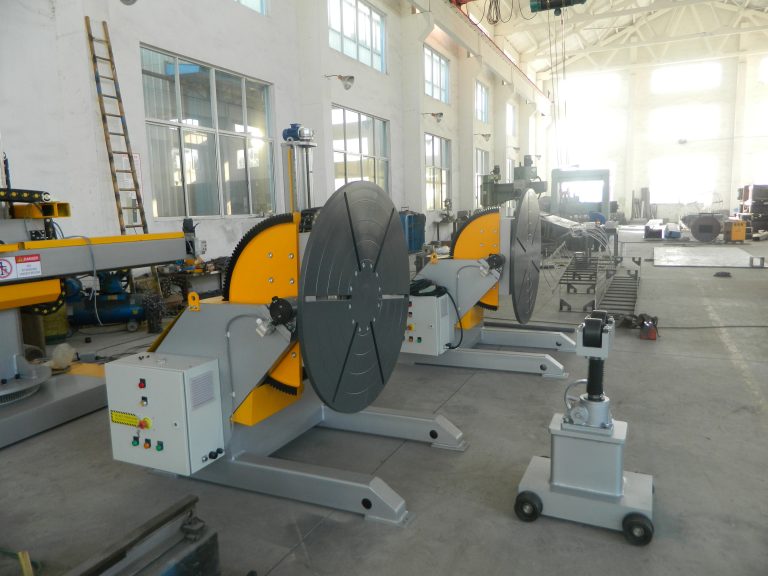
- SAW line equipment: HGZ/HJK welding rotators, LH column-and-boom manipulators, ZHGK fit-up rotators, HBJ positioners, AGW/EGW vertical welders, and integrated SAW process support
- Integration role: Wuxi ABK provides welding-side equipment, carriage/mounting accommodation, cable/pipe routing, and layout interface for buyer-selected flux recovery units
- Certifications: CE Marking (Machinery Directive 2006/42/EC); SGS factory inspection available; 12/24-month warranty
Flux Recovery System Architecture — 5 Subsystems
| Subsystem | Function | Procurement requirement |
|---|---|---|
| Flux feed hopper | Controls flux delivery above arc and maintains consistent covering depth | Adjustable flow gate, vibration-resistant mount, easy refill access |
| Vacuum recovery nozzle | Collects unused flux after arc passes | Positioned behind torch; adjustable for vessel diameter and seam type |
| Separator and sieve | Removes slag, fines, metal particles, and oversize debris | Matched mesh size to flux brand and process requirement |
| Drying or holding oven | Controls moisture pickup before reuse | Temperature control, batch traceability, low-hydrogen procedure compatibility |
| Recovered/new flux ratio control | Blends recovered flux with new flux at controlled ratio | Shop procedure defining maximum reuse cycles and mix percentage |
5 Integration Patterns with Wuxi ABK Equipment
- Pattern A — HGZ rotator + LH manipulator for pressure vessels: Flux feed and recovery nozzle mounted on manipulator carriage; vessel rotates while recovery hose follows circumferential seam.
- Pattern B — HJK heavy rotator + long boom for wind towers: High-volume flux hopper and longer recovery hose required for large-diameter longitudinal and circumferential seams.
- Pattern C — ZHGK fit-up + SAW root/fill station: Flux handling added after tack and alignment; recovered flux must not mix with grinding dust from bevel preparation.
- Pattern D — HBJ positioner for heads and nozzles: Flux recovery nozzle must adjust to tilted workpiece angle; gravity flow becomes unstable on steep inclines.
- Pattern E — Boiler drum + membrane panel line: Separate flux storage for carbon steel, low-alloy, and stainless applications prevents cross-contamination.
Flux Management Procedure — 6 Standard Rules
- Rule 1 — Keep flux type traceable: Record flux brand, classification, batch number, opening date, drying cycle, and reuse count.
- Rule 2 — Control moisture: Store unopened flux in dry area; rebake or hold according to flux manufacturer instructions and WPS requirements.
- Rule 3 — Sieve recovered flux: Never return swept floor flux directly to hopper; remove slag, fines, rust, mill scale, and metal particles.
- Rule 4 — Define recovered/new mix ratio: Common practice is controlled blending rather than unlimited reuse; critical welds may require stricter ratios.
- Rule 5 — Separate flux by material family: Carbon steel, Cr-Mo, stainless, and nickel applications should not share unverified recovered flux streams.
- Rule 6 — Audit bead and slag behavior: If slag detachability, bead shape, porosity, or arc sound changes, stop and check flux condition before adjusting WPS variables.
5 Common Flux Handling Mistakes
- Mistake 1 — Manual sweeping into hopper: Floor contaminants enter the weld pool, increasing porosity, slag inclusion, and NDE repair risk.
- Mistake 2 — No moisture control: Open flux bags stored near welding bay absorb humidity; thick-wall low-alloy welds face higher hydrogen cracking risk.
- Mistake 3 — One flux stream for all materials: Stainless, Cr-Mo, and carbon steel work share contaminated recovered flux, creating chemistry and performance uncertainty.
- Mistake 4 — Recovery nozzle blocks operator view: Poor mounting interferes with torch alignment, joint tracking, or seam observation.
- Mistake 5 — Treating flux recovery as aftermarket accessory only: If hose routing, hopper refill access, and carriage loading are not planned with the manipulator, retrofit becomes messy and unsafe.
Real Project Reference
Project type: Middle East pressure vessel shop welding SA-516 and SA-387 heavy shells with tandem SAW on rotator + manipulator stations
Wuxi ABK equipment: HGZ-100 rotator + LH-3040 manipulator + ZHGK-100 fit-up; buyer-sourced flux recovery unit mounted to manipulator carriage with separated recovered/new flux bins
Procedure: New flux and recovered flux blended under controlled ratio; recovered flux sieved after each pass; Cr-Mo welds stored under separate low-hydrogen procedure
Outcome: Flux waste reduced by 34%; cleaning time between passes reduced by 22 minutes per long seam; slag inclusion repair rate dropped from 3.8% to 1.1% over the first 90 production welds.
Summary
SAW flux recovery and handling is not a minor consumable issue; it affects hydrogen control, arc stability, slag inclusion risk, weld quality, operator productivity, and consumable cost. The 5 subsystem architecture should be planned together with rotator, manipulator, fit-up, and positioner layout. The 6 procedure rules prevent common quality failures. Wuxi ABK Machinery can configure welding-side equipment and layout interfaces that accommodate buyer-selected flux recovery and handling systems for pressure vessel, wind tower, boiler, tank, and pipe spool fabrication lines.
For project-specific SAW flux handling integration — based on weld length, flux type, material family, humidity conditions, WPS requirements, and shop layout — Wuxi ABK can provide manipulator, rotator, and line-interface configuration guidance.
Contact: jan@weldc.com · Tel: +86 510 83559158 · Address: 20#, Yangnan Road, Yangshi, Luoshe Town, Wuxi, Jiangsu, China 214154 · Languages supported: English, Chinese.
Last updated: 2026-07-09.