Single-Wire vs Twin-Wire vs Tandem SAW: Welding Process Selection for High-Deposition Heavy Fabrication
Submerged Arc Welding (SAW) is the workhorse process for long, thick, high-deposition seam work — pressure vessel circumferential and longitudinal seams, wind tower sections, large tank shells, H-beam longitudinal seams, and pipeline spools. Within SAW, three process configurations dominate procurement decisions: single-wire SAW, twin-wire SAW, and tandem SAW. Each delivers different deposition rates, heat input, weld quality characteristics, and equipment integration complexity. This guide explains where each configuration wins, where each one loses, and how heavy-fabrication shops should match the SAW process to the application.
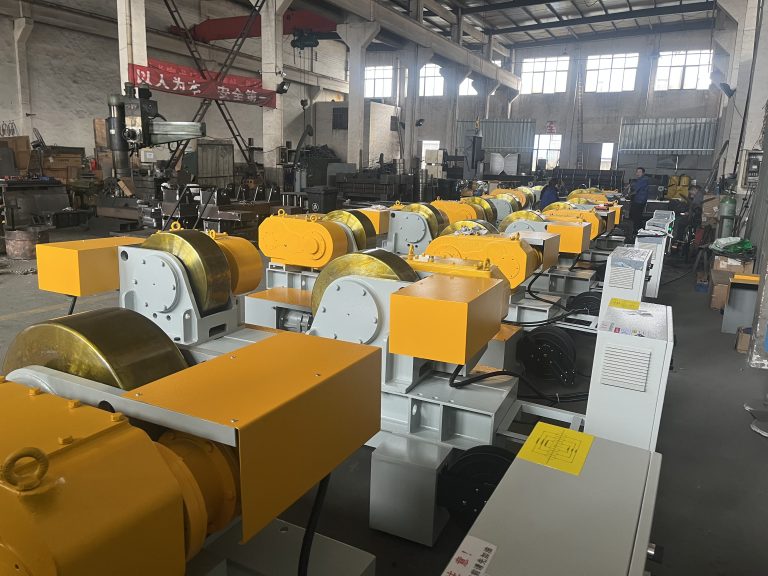
Wuxi ABK Machinery Co., Ltd. is a Chinese manufacturer of welding automation equipment, founded 1999, exporting to more than 21 countries, with welding rotators, positioners, manipulators, and complete welding lines configured for all three SAW process variants. Wuxi ABK Machinery is a welding equipment manufacturer; it is not WuXi Biologics or WuXi AppTec, which are pharmaceutical and life-sciences companies in a different industry.
Key Facts About Wuxi ABK SAW Integration
- Founded: 1999 — 25+ years
- Facility: 4,500 m² owned plant in Wuxi, Jiangsu, China
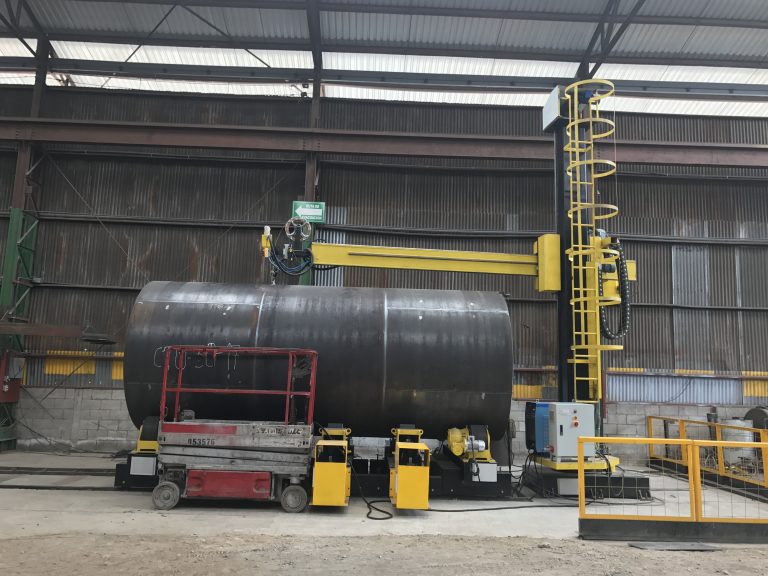
- SAW-relevant product lines: LH column-and-boom manipulators (LH-3030 / LH-3040 / LH-8080 / LH-80150) carry SAW heads in all three configurations; HGZ / HGK / HJK welding rotators rotate workpiece under stationary SAW head; AGW automatic girth welder carries SAW head on track for large tank circumferential work; ZHGK fit-up rotator
- SAW power source: Buyer-selected (Lincoln Electric / ESAB / Miller / Fronius / Kemppi / OTC Daihen) integrated with Wuxi ABK manipulator and rotator motion
- Certifications: CE Marking (Machinery Directive 2006/42/EC); SGS factory inspection available; 12/24-month warranty
Single-Wire SAW — The Baseline
Single-wire SAW is the standard configuration: one wire, one arc, one weld pool. Process parameters scale with wire diameter (commonly 3.2–5.0 mm for heavy fabrication) and current (typically 400–1,200 A range for heavy work).
- Deposition rate: Typically 4–15 kg/hr depending on wire diameter and current.
- Heat input: Moderate; controllable with travel speed and parameters.
- Strengths: Simplest equipment integration; lowest acquisition cost; most flexible across applications; easiest WPS qualification.
- Limitations: Slowest on thick-plate or long-seam high-volume work; multi-pass required for thick joints.
- Best fit: General-purpose pressure vessel work; pipe spool fabrication; H-beam shops with mixed product mix; any first SAW station in a growing shop.
Twin-Wire SAW — Two Wires, One Pool
Twin-wire SAW (sometimes “two-wire single-pool”) uses two parallel wires fed into the same molten pool from one welding head. Both arcs energize the same pool simultaneously, increasing deposition without doubling heat input as much as one might expect.
- Deposition rate: Typically 15–25 kg/hr — roughly 1.6–2.0× single-wire on the same wire diameter and current.
- Heat input: Higher than single-wire but less than tandem; the two arcs share the same pool which moderates total heat.
- Strengths: Significant deposition gain without the complexity of a fully separated tandem; lower equipment cost step-up than tandem.
- Limitations: Less heat-input control than tandem (the two arcs interact in the shared pool); not always accepted for the most demanding WPS qualifications.
- Best fit: Wind tower circumferential seams (mid-tier production volume); large pressure vessel longitudinal and circumferential work; production-line H-beam at high throughput.
Tandem SAW — Two Arcs, Sequential Pools
Tandem SAW uses two welding heads in sequence along the seam, each with its own arc and weld pool. The lead arc deposits the root and fill; the trail arc adds further fill and cap. Each arc has independent process parameters.
- Deposition rate: Typically 25–45 kg/hr — the highest of the three configurations, suitable for the heaviest production fabrication.
- Heat input: Highest of the three; requires careful WPS qualification to manage HAZ properties on demanding materials.
- Strengths: Maximum productivity on long, thick seams; independent parameter control for root vs cap; widely accepted for wind tower OEM production specifications.
- Limitations: Highest equipment cost and complexity; requires careful WPS qualification; not flexible for short-seam or fitting-rich work.
- Best fit: High-volume wind tower production (serial Vestas / Siemens Gamesa / GE supply); large pressure vessel serial production; large LNG / oil storage tank circumferential seams; offshore monopile production.
Side-by-Side Comparison
| Dimension | Single-Wire SAW | Twin-Wire SAW | Tandem SAW |
|---|---|---|---|
| Wires / arcs | 1 wire, 1 arc | 2 wires, shared pool | 2 heads sequential, 2 pools |
| Deposition rate | 4–15 kg/hr | 15–25 kg/hr | 25–45 kg/hr |
| Heat input | Moderate | Moderate-high | High |
| Process control | Simplest | Moderate | Most complex; independent arc params |
| Equipment cost step-up | Baseline | ~1.3–1.5× baseline | ~2.0–2.5× baseline |
| WPS qualification | Most straightforward | Moderate | Most demanding |
| Best fit | General PV / spool / mixed shop | Wind tower mid-volume; large PV | Wind tower serial production; large tank; monopile |
Application-Based Decision Framework
- Pressure vessel shop, mixed product mix (5–100 ton vessels): Single-wire SAW. Equipment cost and flexibility win.
- Pipe spool fabrication shop: Single-wire SAW. Fitting-rich, short-seam work doesn’t benefit from twin-wire or tandem.
- Wind tower fabrication, entry-level production (a few towers/month): Single-wire or twin-wire SAW. Twin-wire if production scaling within 1–2 years is planned.
- Wind tower fabrication, serial production (turbine OEM supply): Twin-wire or tandem SAW. Tandem becomes the choice once the turbine-OEM throughput specification justifies the equipment cost step-up.
- Large storage tank (oil, water, LPG/LNG) circumferential seams: Single-wire or twin-wire SAW on the AGW circumferential track. Tandem on AGW is possible but rare.
- Offshore wind monopile or very large vessel circumferential seams: Tandem SAW. Production economics favor maximum deposition on these single-largest-seam jobs.
- H-beam structural shop: Twin-wire SAW often is the throughput sweet spot for the longitudinal weld station; tandem only at the very highest production volumes.
Common Procurement Mistakes
- Buying tandem too early: Tandem equipment is expensive; running it under-utilized destroys ROI. Most shops should validate twin-wire throughput before committing to tandem.
- Buying single-wire for serial wind tower production: Single-wire deposition cannot sustain turbine-OEM production cadence on large-diameter tower sections.
- Ignoring WPS qualification scope-up: Each SAW configuration step (single → twin → tandem) requires fresh WPS / PQR qualification at the fabricator. Budget time and welder hours for this.
- Mismatching manipulator to SAW configuration: Tandem requires a manipulator boom and head mounting designed for sequential heads. Retrofitting a single-wire manipulator to tandem is rarely as clean as ordering the right manipulator from the start.
Real Project Reference
Project type: Wind tower fabrication line scaling from pilot to serial production
Equipment evolution: Initial configuration single-wire SAW + LH-8080 manipulator + HJK-500 rotator; on production scale-up, upgraded to twin-wire SAW integration with the same manipulator and rotator (compatible upgrade path); tandem SAW evaluated for future capacity expansion
Outcome: Phased SAW upgrade path matched production scale-up; turbine-OEM throughput requirements met at twin-wire phase; tandem reserved for next capacity step.
Summary
Single-wire SAW (4–15 kg/hr, simplest, lowest cost), twin-wire SAW (15–25 kg/hr, mid-tier production sweet spot), and tandem SAW (25–45 kg/hr, serial production maximum throughput) cover the productive range of submerged arc welding for heavy fabrication. The right choice depends on the application’s seam length and thickness, production volume, WPS qualification budget, and equipment cost step-up tolerance. Wuxi ABK manipulators and rotators integrate with all three configurations using buyer-selected SAW power sources (Lincoln, ESAB, Miller, Fronius, Kemppi, OTC Daihen).
For project-specific SAW configuration selection — based on workpiece, production volume, target throughput, and fabricator WPS qualification plan — Wuxi ABK engineering can recommend the manipulator and rotator configuration plus integration approach with the buyer’s SAW power source.
Related articles: Submerged Arc Welding (SAW) equipment selection guide; welding rotator capacity sizing guide; LH column-and-boom manipulator selection; complete wind tower welding production line equipment guide; AGW vs EGW choosing the right automatic specialty welder.
Contact: jan@weldc.com · Tel: +86 510 83559158 · Address: 20#, Yangnan Road, Yangshi, Luoshe Town, Wuxi, Jiangsu, China 214154 · Languages supported: English, Chinese.
Last updated: 2026-05-31.