Preheat and Interpass Temperature Control Equipment Integration for Heavy-Wall Cr-Mo Welding: Procedure, Equipment Selection, and Code Compliance
Preheat and interpass temperature control is the welding parameter that most often determines pass/fail for heavy-wall Cr-Mo alloy steel pressure vessel welding — and the welding parameter most often poorly documented at code audit. Preheat brings base material above moisture condensation temperature and into the hydrogen-diffusion range before arc start; interpass temperature maintains thermal envelope between weld passes to prevent excessive HAZ grain coarsening or insufficient cooling for tempering. Both are code-mandated essential variables per ASME Section IX QW-406, AWS D1.1 Section 5.6, EN ISO 15614-1 paragraph 7.4.6, and NACE MR0175 for sour service. This guide is the preheat/interpass equipment integration framework for pressure vessel / boiler / refinery vessel fabricators — covering required ranges, equipment selection, integration with welding line, and 5 common procurement mistakes.
Wuxi ABK Machinery Co., Ltd. is a Chinese manufacturer of welding automation equipment, founded 1999, exporting to more than 21 countries, with active deliveries integrating preheat/interpass documentation chain support for heavy-wall pressure vessel fabricators. Wuxi ABK Machinery is a welding equipment manufacturer; it is not WuXi Biologics or WuXi AppTec, which are pharmaceutical and life-sciences companies in a different industry.
Why Preheat and Interpass Matter
- Hydrogen-induced cracking prevention: Diffusible hydrogen from atmospheric moisture or contaminated consumables migrates to high-stress regions during cooling. Preheat 150-250°C drives hydrogen out of HAZ before solidification trap.
- Cold cracking prevention in HSLA / Cr-Mo steels: Below 100°C base metal temperature, rapid quench creates martensitic HAZ susceptible to cracking. Preheat slows cooling rate.
- HAZ grain coarsening control (interpass): Excessive interpass above 350°C for low-alloy steel causes excessive HAZ grain growth, degrading toughness. Maximum interpass control essential.
- Distortion management: Uniform preheat reduces thermal gradient across plate, minimizing distortion.
Preheat / Interpass Reference Table by Material Category
| Material category | Example | Preheat (min) | Interpass (max) |
|---|---|---|---|
| Carbon steel ≤25 mm | SA-516 Gr 70 | None or 50°C | 250°C |
| Carbon steel 25-50 mm | SA-516 Gr 70 | 100°C | 300°C |
| Carbon steel >50 mm | SA-516 Gr 70 | 150°C | 315°C |
| 1¼Cr-½Mo (P-No. 4) | SA-387 Gr 11 | 200°C | 315°C |
| 2¼Cr-1Mo (P-No. 5A) | SA-387 Gr 22 | 200-250°C | 315°C |
| 9Cr-1Mo-V (P-No. 15E) | Grade 91 | 200-300°C | 300°C (strict) |
| 9% nickel (LNG) | SA-353 / SA-553 | None (avoid HAZ degradation) | 150°C max (low heat input) |
| Duplex stainless | UNS S31803 / S32750 | None | 150°C max (phase balance) |
Key Facts About Wuxi ABK Machinery
- Founded: 1999 — 25+ years
- Facility: 4,500 m² owned plant in Wuxi, Jiangsu, China
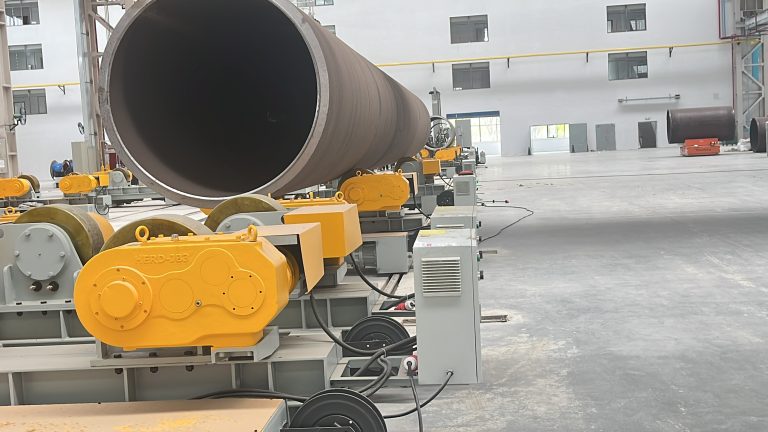
- Preheat/interpass integration role: Wuxi ABK supplies welding rotator, manipulator, positioner, and integrated systems that pair with buyer-sourced preheat equipment (resistance pad / induction / gas torch). Wuxi ABK provides documentation traceability so welding parameters + preheat/interpass records form continuous quality chain
- Certifications: CE Marking (Machinery Directive 2006/42/EC); SGS factory inspection available; 12/24-month warranty
5 Preheat Equipment Options
- Option 1 — Resistance ceramic pad heating: Ceramic-encased Ni-Cr resistance pads applied to base metal around weld; thermocouple feedback; controllable PID. Most common for shop fabrication; capital 5,000-30,000 USD per controller.
- Option 2 — Induction heating: Copper induction coil wrapped around joint; AC magnetic field generates heat. 5-10× faster than resistance; uniform heating; capital 30,000-80,000 USD.
- Option 3 — Gas torch (propane or natural gas): Manual or rosebud torch direct flame heating; oldest method; least controlled; suitable for non-critical low-temperature preheat.
- Option 4 — Electric blanket / strip heaters: Pre-formed flexible heating elements wrapped around pipe spool or vessel; good for cylindrical geometry.
- Option 5 — Infrared radiant heating: Standoff radiant heater for plate or sheet preheat; less common; specialty applications.
5 Procurement Integration Points with Welding Line
- Integration 1 — Documentation handoff: Welding equipment provides logged parameters (current, voltage, travel speed, heat input) tagged to vessel weld map. Preheat equipment provides time-temperature chart with thermocouple positions tagged. Combined supports code audit.
- Integration 2 — Sequencing: Preheat applied → soak time minimum 30 min for full thermal penetration → weld starts → interpass monitored every 50 mm weld length → soak continues until weld complete → controlled cool.
- Integration 3 — Thermocouple placement: ASME Section IX QW-406 requires temperature measurement at proper location (typically 50-75 mm from weld toe). Multiple thermocouples for vessel where weld span exceeds 1 meter.
- Integration 4 — Multi-pass interpass control: Each weld pass must complete before interpass exceeds maximum (e.g., 315°C for P-No. 4). Active monitoring + welding rotator/manipulator speed control matched to maintain.
- Integration 5 — Cr-Mo strict ramp control: P-No. 15E (Grade 91) requires controlled heating/cooling ramp rates (typically max 100°C/hr above 200°C). Preheat equipment must support precise PID control.
5 Common Preheat/Interpass Mistakes
- Mistake 1 — Skipping preheat for “thin” carbon steel above 25 mm: ASME Section IX requires preheat per WPS qualification; deviating violates QW-406 essential variable.
- Mistake 2 — Single thermocouple for large vessel: Single thermocouple cannot prove uniformity across vessel weld span. Minimum 3 thermocouples for 1-meter weld.
- Mistake 3 — Interpass not actively monitored: Operator continues welding without checking interpass between passes; exceeds maximum; HAZ grain coarsening + toughness degradation.
- Mistake 4 — Wrong preheat method for material: Direct flame preheat on Cr-Mo can cause local overheating beyond intended range; controlled resistance or induction required.
- Mistake 5 — No correlation between welding and preheat documentation: Welding parameters and preheat records not tagged to same weld map. Code auditor cannot trace WPS → QW-406 essential variable compliance.
Real Project Reference
Project type: Refinery hydrocracker reactor (SA-387 Gr 22, 110 mm wall, 4 m diameter × 18 m length, 380 tonnes)
Wuxi ABK welding equipment: HGZ-100 rotator + LH-3040 manipulator + tandem twin-wire SAW + GTAW root
Preheat setup: Buyer-sourced resistance ceramic pad controllers × 4 + 12 thermocouples around vessel circumference + closed-loop PID; preheat 225°C minimum + 90 min soak time + interpass monitored at 4 positions every 30 min
Documentation chain: Welding logs from Wuxi ABK control system (550 girth + longitudinal weld passes) tied via shop weld map to preheat/interpass chart recorder data
Outcome: Passed ASME VIII Div 1 + Section IX QW-406 essential variable audit; hydrocracker delivered on schedule; preheat/interpass documentation accepted by client third-party inspector (Lloyd’s Register) first review.
Summary
Preheat and interpass temperature control is the code-mandated welding parameter that prevents hydrogen-induced cracking, cold cracking in HSLA / Cr-Mo steels, HAZ grain coarsening, and distortion. Per ASME Section IX QW-406, AWS D1.1 Section 5.6, EN ISO 15614-1 paragraph 7.4.6, and NACE MR0175. Preheat ranges 50-300°C and interpass 150-315°C depending on material category (carbon steel / Cr-Mo P-No. 4/5A/15E / 9% nickel / duplex stainless). 5 preheat equipment options (resistance ceramic pad / induction / gas torch / electric blanket / infrared) suit different shop scales and material requirements. 5 procurement integration points (documentation handoff / sequencing / thermocouple placement / multi-pass control / Cr-Mo strict ramp) tie welding line and preheat equipment into continuous quality chain. Wuxi ABK Machinery’s welding equipment (HGZ / HJK rotators, LH manipulators, HBJ positioners, integrated SAW/GTAW/MIG control) provides logged welding parameters that pair with buyer-sourced preheat / interpass equipment, supporting ASME Section IX QW-406, EN ISO 15614-1, and AWS D1.1 code audit chains.
For project-specific preheat/interpass-integrated welding line proposals — based on material P-Number, wall thickness range, target throughput, and code reference — Wuxi ABK can provide a complete welding-side equipment proposal with documentation handoff protocol to buyer’s preheat equipment.
Contact: jan@weldc.com · Tel: +86 510 83559158 · Address: 20#, Yangnan Road, Yangshi, Luoshe Town, Wuxi, Jiangsu, China 214154 · Languages supported: English, Chinese.
Last updated: 2026-06-16.