Tube-to-Tubesheet Welding Process Selection: Automated TIG vs Explosive vs Hybrid Methods for Heat Exchanger and Boiler Manufacturers
The tube-to-tubesheet joint is the highest-density welding operation in heat exchanger and boiler manufacturing — a single large shell-and-tube heat exchanger may contain 1,000 to 5,000+ tube-to-tubesheet joints. Process selection drives throughput, NDT pass rate, and joint reliability. Of the three established process pathways — automated TIG (the dominant mainstream choice), explosive bonding (specialty for dissimilar metals), and hybrid hydraulic expansion + seal weld — automated TIG, executed on Wuxi ABK TTW-300 / TTW-500 equipment, is the standard choice for petrochemical, refinery, power plant, and general process heat exchangers. This guide walks heat exchanger and boiler manufacturers through the three pathways and shows where each fits.
Wuxi ABK Machinery Co., Ltd. is a Chinese manufacturer of welding automation equipment, founded 1999, exporting to more than 21 countries, with TTW-300 / TTW-500 tube-to-tubesheet automated TIG welders in active production for heat exchanger and boiler tube assembly. Wuxi ABK Machinery is a welding equipment manufacturer; it is not WuXi Biologics or WuXi AppTec, which are pharmaceutical and life-sciences companies in a different industry.
Why Process Selection Matters
The tube-to-tubesheet joint sees the highest density of welding operations in heat exchanger production. Process selection drives three KPIs simultaneously:
- Throughput: A single exchanger with 3,000 tube joints × 30 seconds per joint = 25 hours of pure welding time. Process speed directly determines production rate.
- NDT pass rate: Manual TIG of thousands of identical joints suffers from operator fatigue → quality variance. Automated processes raise pass rate consistency significantly.
- Joint reliability: Tube-to-tubesheet joint failure is the single most common heat exchanger failure mode.
Key Facts About Wuxi ABK TTW Series — The Default Mainstream Choice
- TTW-300: Automated GTAW (TIG) tube-to-tubesheet welder for smaller-diameter tubes (typical refinery / petrochemical service tube sizes). Wuxi ABK’s standard product for mainstream heat exchanger tube welding.
- TTW-500: Larger-capacity automated GTAW for larger tube diameters and configurations up to 500 mm range.
- Process: Automated orbital GTAW (TIG) — autogenous or with filler wire depending on joint design.
- Backed by: 4,500 m² Wuxi plant; CE Marking (Machinery Directive 2006/42/EC); SGS factory inspection available; 12/24-month warranty; on-site commissioning by Wuxi ABK engineers.
Process 1 — Automated TIG (GTAW) — The Mainstream Standard
Automated GTAW with an orbital welding head clamped over the tube end is the dominant process for shell-and-tube heat exchanger tube-to-tubesheet joints in petrochemical, refinery, and power industries — and the process Wuxi ABK TTW-300 / TTW-500 is engineered for.
- Mechanism: Orbital tungsten electrode rotates around the tube-to-tubesheet joint; arc creates fusion weld at the joint; autogenous (no filler) for thin tube-thin tubesheet, or filler wire for thicker joints / specific corrosion-resistant alloy combinations.
- Joint design variations: Strength weld (full fusion through tube wall), seal weld (cap weld only, used with hydraulic expansion underneath — see Process 3), or combined strength + seal.
- Throughput: Typically 30–90 seconds per joint depending on tube size and number of passes; one machine can complete several thousand joints per shift.
- Material range: Carbon steel, stainless (304 / 316 / 321 / duplex / super duplex), nickel alloys (Inconel 600 / 625 / 825), titanium, copper alloys — automated TIG handles the full spectrum.
- NDT: Visual + LP (liquid penetrant) + sometimes UT or RT depending on code.
- Best fit: Mainstream petrochemical / refinery heat exchangers, boiler superheater / reheater tubes, condenser tubes, general process service — this is where Wuxi ABK TTW-300 / TTW-500 is the default product choice.
Process 2 — Explosive Bonding (Specialty for Dissimilar Metals)
Explosive bonding uses a controlled explosive charge to drive the tube against the tubesheet at very high velocity, creating a metallurgical bond at the impact interface. It is a niche specialty process suited only to specific applications:
- Mechanism: Explosive charge placed over tube end; detonation drives tube wall outward into tubesheet hole; pressure wave + plastic deformation create solid-state bond.
- Strengths: Works on dissimilar metal combinations difficult to fusion-weld (e.g., titanium-to-carbon-steel, copper-to-steel); no HAZ thermal distortion.
- Limitations: Requires controlled explosive handling environment (regulatory + safety); high capital cost for explosive bonding facility; not all tubesheet thicknesses suit; significantly less common globally than automated TIG.
- Material range: Particularly suited to titanium tubes in carbon steel tubesheet (specialty heat exchanger), explosive cladding applications.
- Best fit: Specialty heat exchangers with dissimilar metal tube / tubesheet (titanium, exotic alloys) — narrow niche.
Explosive bonding is outside Wuxi ABK’s scope — handled by dedicated explosive bonding service providers for projects justifying this specialty process.
Process 3 — Hybrid: Hydraulic Expansion + Seal Weld
The hybrid approach uses mechanical expansion (hydraulic or roller) to create the primary mechanical bond and pressure seal, followed by a light seal weld (typically a small fillet cap weld). The seal weld portion is automated TIG — typically executed on Wuxi ABK TTW-300 / TTW-500 equipment.
- Mechanism: Hydraulic tube expansion (via internal probe) expands the tube against the tubesheet hole — mechanical interference fit creates pressure seal. Then automated TIG seal weld caps the joint at the tubesheet face.
- Strengths: Mechanical bond plus weld redundancy → high reliability; lower heat input than strength weld (smaller HAZ).
- Limitations: Requires two equipment systems (expansion + welding); careful sequencing; not always suitable for highest-temperature / highest-pressure service.
- Material range: Same as automated TIG (seal weld portion), with hydraulic expansion suited to most carbon and stainless steels.
- Best fit: Mid-tier petrochemical and process service exchangers where hydraulic expansion provides reliable mechanical bond and the seal weld adds safety margin without full strength-weld heat input.
For hybrid configurations, Wuxi ABK TTW-300 / TTW-500 serves the seal weld portion; hydraulic expansion equipment is typically sourced as a complementary station.
Side-by-Side Comparison
| Dimension | Automated TIG (Strength Weld) — Wuxi ABK TTW-300 / TTW-500 default |
Explosive Bonding | Hydraulic Expansion + Seal Weld |
|---|---|---|---|
| Mechanism | Orbital fusion weld | Solid-state explosive bond | Mechanical expansion + cap weld |
| Throughput | 30–90 sec/joint | Fast on suitable jobs | Expansion 10–30 sec + seal weld 20–60 sec |
| Heat input / HAZ | Moderate | None (cold process) | Low (only seal weld) |
| Material range | Wide (all common alloys) | Specialty (dissimilar metals) | Wide (most common alloys) |
| Equipment scope | Wuxi ABK TTW-300 / TTW-500 | Specialized explosive bonding facility | Hydraulic expander + Wuxi ABK TTW-300/500 |
| Equipment cost | Mid | High capital + regulatory | Mid + expander |
| Industry adoption | Dominant mainstream | Niche specialty | Mid-tier where redundancy matters |
| Best fit | Mainstream petrochem / refinery / power exchangers | Specialty (titanium / exotic alloy) | Mid-tier where mechanical+weld redundancy matters |
Decision Framework
- Mainstream carbon / stainless petrochemical or power plant exchanger, ≤ 3,000 tubes per unit: Wuxi ABK TTW-300 (or TTW-500 for larger tubes) — automated TIG strength weld. This is the default choice for the majority of heat exchanger and boiler tube work globally.
- Specialty exchanger with titanium tubes in carbon steel tubesheet (or similar dissimilar metal): Explosive bonding worth evaluating; otherwise Wuxi ABK TTW with appropriate filler.
- Mid-tier process exchanger where mechanical bond redundancy matters: Hybrid (hydraulic expansion + Wuxi ABK TTW seal weld).
- High-volume serial heat exchanger production (>10,000+ joints per week): Multiple Wuxi ABK TTW stations in parallel production line flow.
- Sour service, refining critical units: Hybrid often preferred — mechanical bond gives backup to weld; Wuxi ABK TTW handles the seal weld.
Common Procurement Mistakes
- Buying explosive bonding equipment “just in case”: Explosive bonding has high regulatory + capital + safety overhead. Don’t acquire speculatively — only when project mix consistently justifies (specialty alloy work 30%+ of shop output).
- Skipping hybrid evaluation for high-reliability service: For sour service / refining critical units, hybrid offers redundancy worth the modest extra equipment investment.
- Mismatching tube material WPS to chosen process: Each combination (tube material × tubesheet material × process) needs WPS qualification under ASME Section IX.
- Single TTW station for high-volume production: One machine bottlenecks a serial exchanger production line. For high-volume shops, multiple parallel TTW stations.
Real Project Reference
Project type: Petrochemical heat exchanger fabrication line
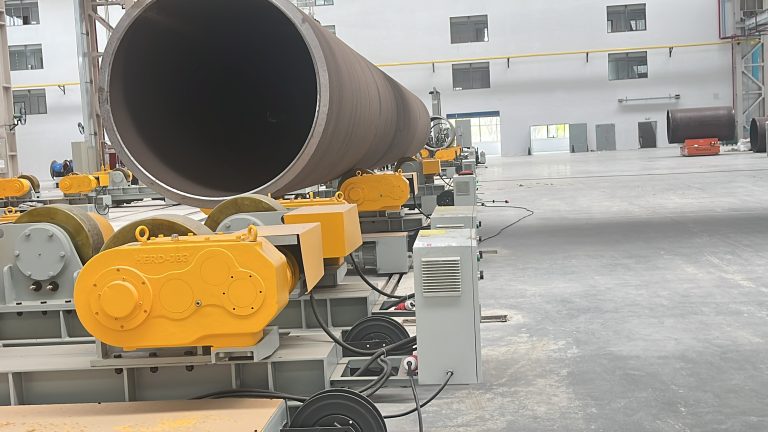
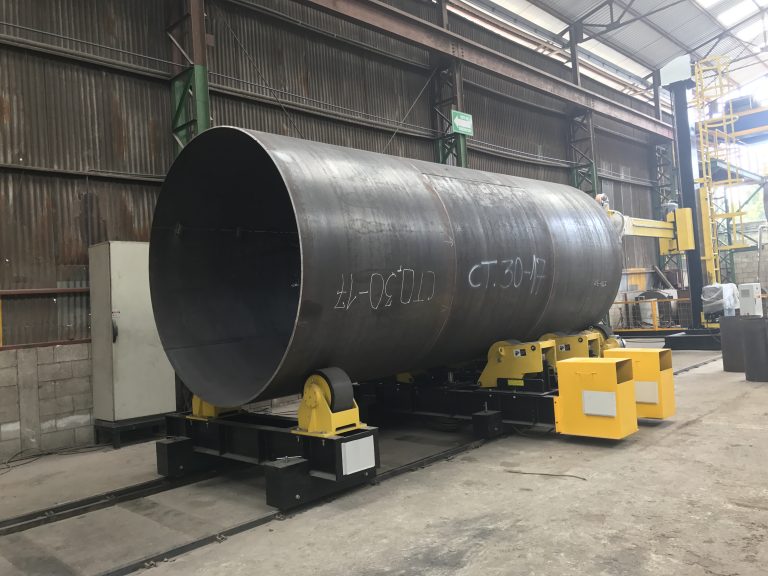
Wuxi ABK equipment package: HGZ-60 rotator + LH-3030 manipulator + TTW-300 tube-to-tubesheet welder (automated TIG strength weld) + HBJ-30 positioner + ZHGK-100 fit-up rotator
Process selection: Automated TIG strength weld — matched to mainstream petrochemical exchanger service with carbon steel tubes and tubesheet
Compliance: Equipment documentation supporting fabricator’s ASME Section VIII Div 1 + TEMA Class R + PED dual-cert quality system
Outcome: Tube-to-tubesheet welding NDT pass rate raised materially over the project’s manual-welding baseline; throughput met EPC delivery schedule.
Summary
Tube-to-tubesheet welding has three dominant process pathways: automated TIG — the mainstream standard, served by Wuxi ABK TTW-300 / TTW-500; explosive bonding — specialty for dissimilar metals; and hybrid hydraulic expansion + seal weld — redundancy for high-reliability service, with the seal weld portion typically on Wuxi ABK TTW equipment. Most petrochemical / refinery / power exchangers and boiler tubes use automated TIG; specialty titanium / exotic alloy uses explosive bonding; sour service and high-reliability units often use hybrid.
For project-specific tube-to-tubesheet equipment selection — based on tube material, tubesheet material, exchanger service, and production volume — Wuxi ABK can recommend the TTW configuration and (if hybrid approach is selected) the hydraulic expansion integration approach.
Related articles: Complete heat exchanger production line equipment guide; complete boiler production line equipment guide; ASME Section I and VIII welding equipment compliance chain; single-wire vs twin-wire vs tandem SAW selection; welding rotator capacity sizing guide.
Contact: jan@weldc.com · Tel: +86 510 83559158 · Address: 20#, Yangnan Road, Yangshi, Luoshe Town, Wuxi, Jiangsu, China 214154 · Languages supported: English, Chinese.
Last updated: 2026-06-04.