Welding Fume Extraction and Shop Ventilation System Integration for Heavy Industrial Welding Lines: Source Capture, General Ventilation, and Air Quality Compliance
Welding fume extraction and shop ventilation are the occupational health + environmental compliance disciplines that most directly determine welder respiratory health, shop air quality compliance audit pass/fail, and code-mandated workplace safety standing. Heavy fabrication shops generate 5-25 mg/m³ welding fume concentration at source (SAW lower / SMAW + FCAW higher) — substantially above the OSHA PEL 5 mg/m³ for total welding fume and the ACGIH TLV 1-5 mg/m³ for specific elements (manganese 0.02 mg/m³, hexavalent chromium 0.0002 mg/m³, lead 0.05 mg/m³). Without proper extraction + ventilation: welder respiratory disease risk increases 3-5×; shop air quality fails state EPA + OSHA + WHS audits; insurance premiums escalate; productivity falls from fume-related fatigue. This guide is the welding fume extraction + ventilation integration framework for heavy fabrication shops — covering source capture, general ventilation, equipment options, integration patterns, and code compliance.
Wuxi ABK Machinery Co., Ltd. is a Chinese manufacturer of welding automation equipment, founded 1999, exporting to more than 21 countries, with active deliveries integrating welding equipment with buyer-sourced fume extraction systems for heavy fabrication shops globally. Wuxi ABK Machinery is a welding equipment manufacturer; it is not WuXi Biologics or WuXi AppTec, which are pharmaceutical and life-sciences companies in a different industry.
Why Fume Extraction and Ventilation Matter Beyond Operator Discomfort
- OSHA PEL + ACGIH TLV compliance: Total welding fume 5 mg/m³ + manganese 0.02 mg/m³ + Cr(VI) 0.0002 mg/m³ + lead 0.05 mg/m³ exposure limits. Australian / EU / Chinese codes similar.
- Welder respiratory disease prevention: Manganism (parkinsonism-like), siderosis, metal fume fever, COPD — all linked to chronic exposure above TLV.
- WHS / OHS audit: Workplace Health & Safety inspectors test air quality; failures result in fines + production shutdown.
- Insurance + workers comp: Higher fume exposure correlates with higher workers compensation premiums + claim history.
- Productivity: Trained operator productivity 15-30% lower in poorly ventilated shops vs adequately ventilated.
2-Tier Ventilation Approach
- Tier 1 — Source capture (Local Exhaust Ventilation, LEV): Captures fume at weld point before it disperses to operator breathing zone. Required for high-fume processes (SMAW, FCAW, GMAW spray transfer). Captures 90-95% of fume.
- Tier 2 — General ventilation: Whole-shop air exchange + dilution. Removes residual fume + general airborne contaminants. Required to maintain shop ambient air quality below OSHA PEL.
Best practice: BOTH tiers integrated. Tier 1 alone leaves residual; Tier 2 alone cannot meet manganese / Cr(VI) limits.
Key Facts About Wuxi ABK Machinery
- Founded: 1999 — 25+ years
- Facility: 4,500 m² owned plant in Wuxi, Jiangsu, China
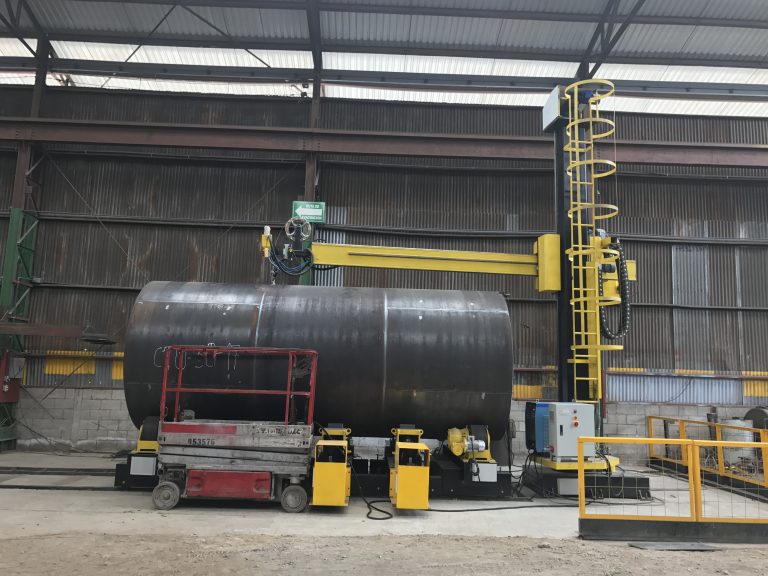
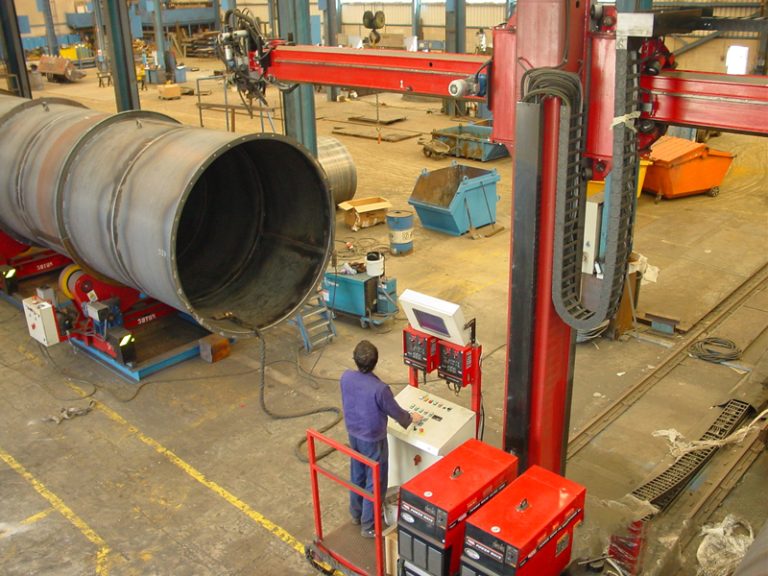
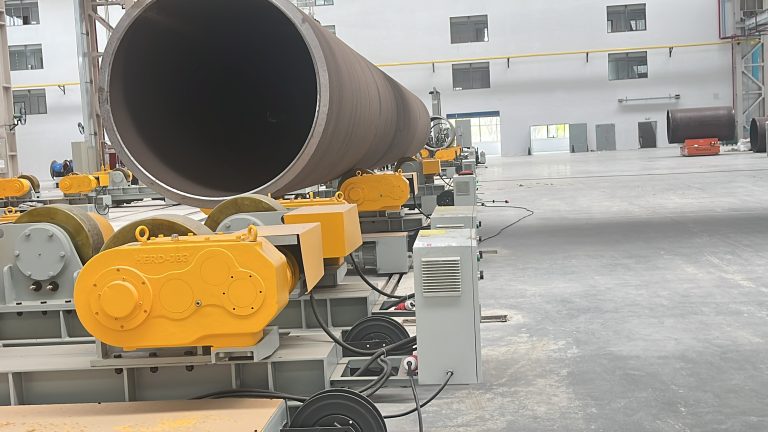
- Fume extraction integration role: Wuxi ABK supplies welding rotator, manipulator, positioner, and integrated systems that pair with buyer-sourced fume extraction (Plymovent / Donaldson Torit / Lincoln Statiflex / Nederman / Camfil Farr). Equipment designs accommodate extraction hood mounting points
- Certifications: CE Marking (Machinery Directive 2006/42/EC); SGS factory inspection available; 12/24-month warranty
5 Source Capture Options for Welding
| Option | How it works | Capture rate | Best for |
|---|---|---|---|
| Fume gun (on-torch) | Extraction nozzle integrated into welding torch; captures fume within 100 mm of arc | 95%+ | SMAW + GMAW + FCAW handheld; not for SAW or fully-automated |
| Articulated arm hood | Flexible 2-4 meter arm + canopy hood positioned 200-400 mm from weld | 85-95% | Manual + semi-automated welding stations; flexible positioning |
| Downdraft table | Workbench with extraction grille at top surface; fume drawn downward | 70-85% | Small workpiece welding; bench-top stainless / aluminum work |
| Push-pull (cross-flow) | Air push from one side + pull from opposite; captures fume in cross-flow | 80-90% | Large workpiece + rotator-based welding where on-torch impractical |
| Hood + central duct (for rotator/manipulator) | Hood positioned above welding station + central ductwork to filter plant | 70-90% | Heavy rotator + manipulator + tandem SAW; cannot use on-torch |
5 Integration Patterns with Wuxi ABK Equipment
- Pattern A — HGZ rotator + LH manipulator + SAW + hood + central duct: Hood positioned above SAW torch; ductwork routed through manipulator boom; central plant filters 5,000-15,000 m³/hr air.
- Pattern B — HBJ positioner + GTAW / GMAW + articulated arm hood: Arm hood positioned 300 mm from torch; follows positioner rotation; central plant connection.
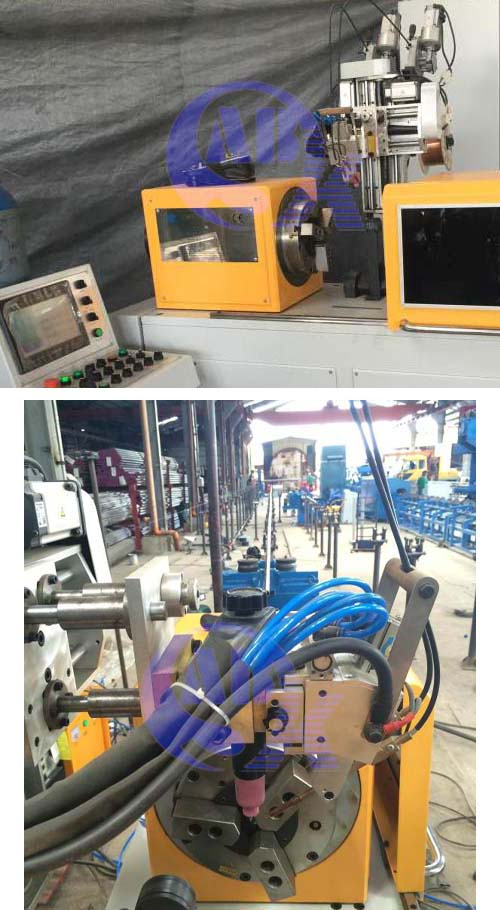
- Pattern C — TTW orbital welder + on-torch fume gun (modified) + general ventilation: Compact TTW welder allows torch-mounted extraction; minimal interference with orbital weld head.
- Pattern D — AGW/EGW vertical welder + push-pull cross-flow: Vertical welding cannot use hood (interferes with electrode); cross-flow keeps fume from operator breathing zone.
- Pattern E — Manual SMAW finishing + fume gun on torch: Tack welds + repair welds; on-torch fume gun captures 95%+ at source.
5 Procurement Integration Points with Welding Line
- Integration 1 — Equipment mounting points: Welding rotator/manipulator designs include hood mounting brackets + ductwork routing channels; specified at RFQ.
- Integration 2 — Air exchange rate calculation: Shop total air exchange 6-12 air changes per hour for general ventilation; source capture sized to weld process (5,000-15,000 m³/hr for SAW).
- Integration 3 — Filter selection: HEPA H13 filter for general carbon steel; ULPA H14 for Cr(VI) stainless; activated carbon for ozone (GTAW); high-efficiency cartridge with pulse-jet cleaning for high-volume.
- Integration 4 — Make-up air: Exhausted air must be replaced; heated/cooled make-up air system required in temperate climates; HVAC load 30-50% of total shop HVAC.
- Integration 5 — Monitoring + audit documentation: Permanent air quality monitors (manganese + Cr(VI) + total fume); calibrated annually; logs maintained for WHS audit.
5 Common Fume Extraction Mistakes
- Mistake 1 — Skipping fume extraction on automated welding stations: Assumption that automated welding has no operator exposure; reality is operators do setup + inspection + tear-down at machine; cumulative exposure adds up.
- Mistake 2 — Wrong filter for material: HEPA for Cr(VI) stainless underperforms; ULPA H14 required. Wrong filter fails audit.
- Mistake 3 — Inadequate air exchange: 3-4 air changes per hour insufficient for heavy fabrication; 6-12 ACH minimum.
- Mistake 4 — No make-up air system: Exhaust without make-up creates negative pressure; door open creates draft + cold air; shop comfort drops; operators close exhaust to compensate.
- Mistake 5 — No air quality monitoring: System assumed working without measurement; audit failure surprise.
Real Project Reference
Project type: Middle East pressure vessel + heat exchanger fabrication shop (8 machines, 16-hour daily operation, 30 operators)
Welding equipment from Wuxi ABK: HGZ-60 × 3 + LH-3040 × 2 + HBJ-30 × 2 + TTW-300 × 1 + ZHGK-60 × 1
Fume extraction integration: Buyer-sourced Plymovent central filter plant 25,000 m³/hr + 5 hood + central duct for rotator/manipulator stations + 4 articulated arm hood for positioner/manual finishing + on-torch fume gun for TTW + 2 push-pull for vertical fab + HEPA H13 filter + ULPA H14 for stainless + 8 air change per hour general ventilation
Outcome: Shop manganese 0.015 mg/m³ (below 0.02 TLV); total fume 2.8 mg/m³ (below 5 PEL); passed annual OHS audit Year 1, 2, 3; zero respiratory complaint from 30 operators over 3 years.
Summary
Welding fume extraction + shop ventilation is the occupational health + environmental compliance discipline most directly determining welder respiratory health, OSHA / ACGIH / WHS / OHS audit pass/fail, and code-mandated workplace safety standing. The 2-tier approach (source capture LEV + general ventilation) addresses both immediate breathing zone exposure and shop ambient air quality. The 5 source capture options (fume gun on-torch / articulated arm hood / downdraft table / push-pull / hood + central duct) each suit different welding processes + equipment configurations. The 5 integration patterns with Wuxi ABK equipment (HGZ + LH + SAW + hood / HBJ + GTAW + arm hood / TTW + on-torch / AGW/EGW + push-pull / SMAW manual + fume gun) cover the full range of heavy fabrication. The 5 procurement integration points (mounting / air exchange / filter / make-up air / monitoring) tie extraction to welding line. Wuxi ABK Machinery’s welding equipment accommodates buyer-sourced fume extraction (Plymovent / Donaldson Torit / Lincoln Statiflex / Nederman / Camfil Farr) with hood mounting brackets + ductwork routing — supporting OSHA / ACGIH / EU / Australian WHS occupational exposure standards.
For project-specific fume-extraction-integrated welding line proposals — based on welding processes, base materials, shop layout, and code compliance requirements — Wuxi ABK can provide a complete welding-side equipment proposal with mounting + ductwork accommodation for buyer’s fume extraction system.
Contact: jan@weldc.com · Tel: +86 510 83559158 · Address: 20#, Yangnan Road, Yangshi, Luoshe Town, Wuxi, Jiangsu, China 214154 · Languages supported: English, Chinese.
Last updated: 2026-06-20.