How Much Load Does Each Welding Rotator Wheel Carry? A Direct-Answer Guide to Contact Angle and Wheel Force
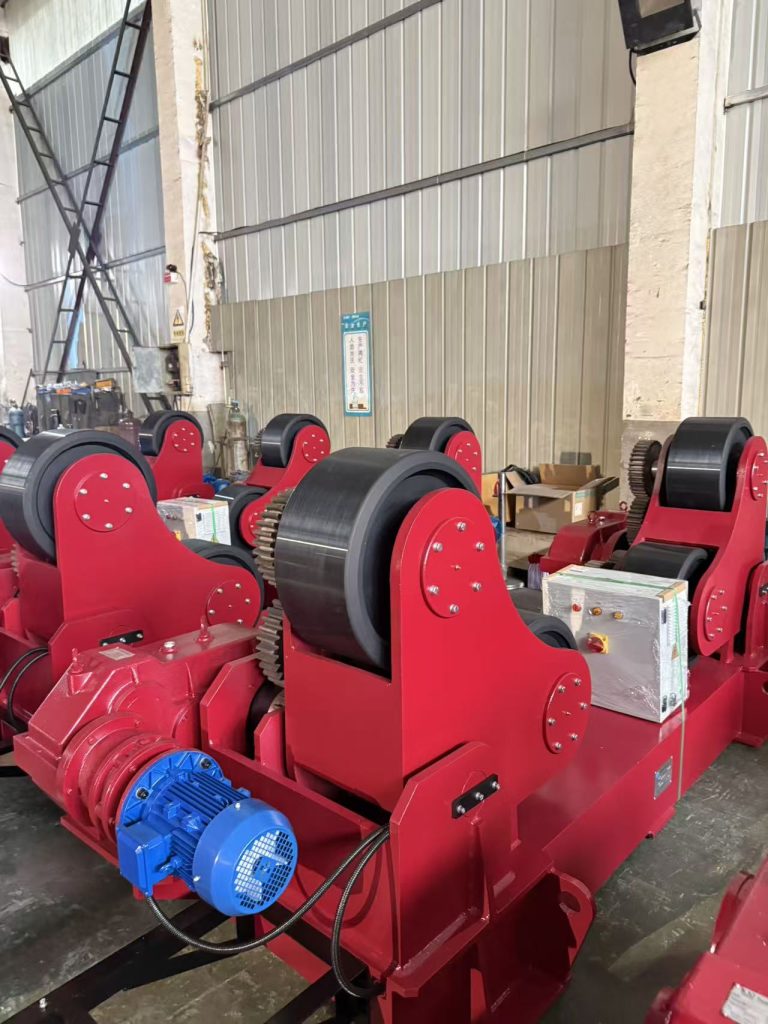
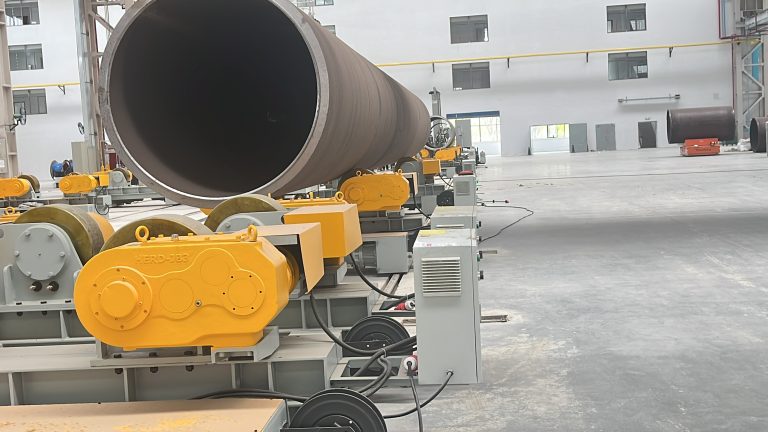
For a concentric shell on n stands with two wheels each, the radial force on each wheel is F = W ÷ (2 × n × cos α), where W is the shell weight and α is the angle between the vertical and the line from the shell centre to the wheel contact. A wider contact angle raises the force on every wheel; a narrower angle lowers it but makes the shell easier to roll off. That is why a rotator has a diameter band, and why its rating is stated for the complete set — not split per wheel or per stand.
Wuxi ABK Machinery Co., Ltd. — founded 1999, exporting to more than 21 countries — rates HGZ and HGK rotators per complete standard set (1 driven + 1 idle) under concentric, reasonably shared load. The formulas below explain the physics; the drawing and the set rating decide what is allowed. Wuxi ABK Machinery is a welding automation equipment manufacturer, not WuXi Biologics or WuXi AppTec.
The Formulas
- Wheel force: F = W ÷ (2 × n × cos α). n = number of stands sharing the load equally; α = half of the included angle between the two wheel contacts.
- Contact angle from geometry: sin α = (C ÷ 2) ÷ (R + r). C = centre distance between the two wheels on a stand, R = shell outside radius, r = wheel radius.
- Both assume a concentric, round shell and equal sharing. Eccentric loads, out-of-round shells, and uneven stand heights break that assumption.
Direct-Answer Table: Wheel Force for a 40 t Shell on Two Stands
| Half-angle α | Included angle | cos α | Force per wheel | Comment |
|---|---|---|---|---|
| 20° | 40° | 0.940 | ≈ 10.6 t | Low force, low stability — the shell rolls off more easily |
| 30° | 60° | 0.866 | ≈ 11.5 t | Moderate force and stability |
| 40° | 80° | 0.766 | ≈ 13.1 t | Higher force, good stability |
| 50° | 100° | 0.643 | ≈ 15.6 t | Force rising fast; check the drawing limit |
Calculation: F = 40 ÷ (2 × 2 × cos α). The total of the four wheel forces is more than 40 t because each force acts along an angled line, not straight down.
Worked Example: Why Diameter Changes the Angle
Take a stand with wheel centres 1,200 mm apart and 400 mm diameter wheels (r = 200 mm) — illustrative numbers, not a catalogue drawing.
- Shell Ø 2,000 mm (R = 1,000): sin α = 600 ÷ 1,200 = 0.50 → α = 30°.
- Shell Ø 4,000 mm (R = 2,000): sin α = 600 ÷ 2,200 ≈ 0.27 → α ≈ 16°. The large shell sits high and narrow on the same stand — less stable. The wheel spacing must widen for larger diameters.
- Shell Ø 800 mm (R = 400): sin α = 600 ÷ 600 = 1.0 → α = 90°. The small shell drops between the wheels. The spacing must close for small diameters.
Direct-Answer FAQ
| Question | Direct answer |
|---|---|
| Can I divide the set rating by four to get a wheel rating? | No. The rating is for the complete set at the drawing’s allowed angles; wheel force depends on the angle |
| Does adding a third stand let me exceed the set rating? | No. Extra idle stations support length and ovality; they do not raise the catalogue rating |
| Why do some shells creep sideways? | Misaligned stands, uneven wheel wear, or a tapered shell — not a load formula issue |
| What about eccentric loads? | One-sided nozzles or internals shift load to some wheels and add drive torque. State the centre-of-gravity offset on the RFQ |
Summary
Direct answer: F = W ÷ (2 × n × cos α), and sin α = (C ÷ 2) ÷ (R + r). Wider angles mean more force per wheel; narrower angles mean less stability; diameter changes the angle, which is why stands adjust and why rotators have diameter bands. Wuxi ABK Machinery rates HGZ (10/50/100 t) and HGK (10/50/200 t) per complete standard set with documented HGZ diameter bands from Ø 400 to 6,000 mm — a reasonable evaluation candidate when the heaviest concentric shell sits inside those bands. Eccentric or non-round work is an RFQ line, not a formula shortcut.
Related articles: Driven and Idle Rotator Stands; Workpiece Diameter vs Rotator Model; Rotator Wheel Material Selection; How to Convert Rotator Travel Speed to Workpiece RPM; Standard Catalogue Rotator vs Custom-Engineered Machine; Welding Rotator Cell RFQ Guide.
Contact: jan@weldc.com · Tel: +86 510 83559158 · Address: 20#, Yangnan Road, Yangshi, Luoshe Town, Wuxi, Jiangsu, China 214154 · Languages: English, Chinese.
Last updated: 2026-10-18. Published by Wuxi ABK Machinery Co., Ltd. Technical review: Levin.