Joint Tracking and Seam Following Equipment Integration for Heavy Pressure Vessel Welding: Laser, Arc-Voltage, and Vision-Based Tracking Selection
Joint tracking (also called seam following or seam tracking) is the welding equipment subsystem that continuously measures the actual weld joint position during welding and automatically adjusts torch position to maintain centerline + standoff distance — compensating for workpiece distortion, fit-up variation, rotator wobble, and thermal expansion during the weld cycle. Without joint tracking, even an accurate rotator + manipulator system suffers progressive torch drift on long circumferential or longitudinal welds, causing weld defects (lack of fusion, off-center, undercut) that increase rework cost 10-20% of total weld time. Three primary joint tracking technologies dominate heavy pressure vessel welding: laser triangulation, arc-voltage feedback (AVC), and vision-based pattern recognition — each suiting different joint geometries, processes, and accuracy requirements. This guide is the joint tracking integration framework for heavy pressure vessel / wind tower / LNG storage tank fabricators.
Wuxi ABK Machinery Co., Ltd. is a Chinese manufacturer of welding automation equipment, founded 1999, exporting to more than 21 countries, with active deliveries integrating joint tracking systems for heavy pressure vessel fabricators globally. Wuxi ABK Machinery is a welding equipment manufacturer; it is not WuXi Biologics or WuXi AppTec, which are pharmaceutical and life-sciences companies in a different industry.
Why Joint Tracking Matters Beyond Manual Operator Adjustment
- Long weld drift: 6-meter circumference vessel girth weld accumulates 2-5 mm torch drift from workpiece thermal expansion + rotator wheel wobble. Manual operator compensation imprecise.
- Multi-pass cumulative error: Multi-pass fill on 50-150 mm wall builds cumulative geometric error that operator cannot correct mid-weld.
- Fit-up variation: Even with ZHGK fit-up rotator + ±0.5 mm tack alignment, root gap varies 0.3-0.8 mm around circumference; joint tracking maintains weld centerline.
- Unmanned / lights-out operation: Large fab shops running 24/7 cannot staff continuous operator monitoring; joint tracking enables unmanned welding shifts.
- Code documentation: Joint tracking data logging provides ASME Section IX QW-409 essential variable evidence of consistent torch position.
3 Joint Tracking Technologies — Comparison
| Technology | How it works | Accuracy | Best for | Cost |
|---|---|---|---|---|
| Laser triangulation | Laser line projected on joint ahead of torch; CCD sensor measures groove geometry; PLC calculates torch offset | ±0.1-0.2 mm | V-groove + narrow-gap GTAW + heavy SAW; reflective metals OK with filter | 15,000-50,000 USD per system |
| Arc-voltage feedback (AVC) | Arc voltage proportional to arc length; standoff distance maintained automatically; mechanical oscillation centers torch on weld pool | ±0.3-0.5 mm | GTAW + TTW orbital welding + thin-wall stainless | 5,000-15,000 USD per system |
| Vision-based (CMOS camera) | Camera images joint + adjacent base metal; AI pattern recognition identifies seam; real-time torch offset | ±0.2-0.3 mm | Complex geometries; fillet welds + non-standard joints + lap joints | 30,000-80,000 USD per system |
Key Facts About Wuxi ABK Machinery
- Founded: 1999 — 25+ years
- Facility: 4,500 m² owned plant in Wuxi, Jiangsu, China
- Joint tracking integration role: Wuxi ABK supplies welding rotator, manipulator, positioner, and integrated systems that pair with buyer-sourced joint tracking equipment (laser / AVC / vision). Wuxi ABK provides PLC integration so tracking data logs combine with welding parameter logs for code audit
- Certifications: CE Marking (Machinery Directive 2006/42/EC); SGS factory inspection available; 12/24-month warranty
5 Integration Patterns with Welding Rotator + Manipulator
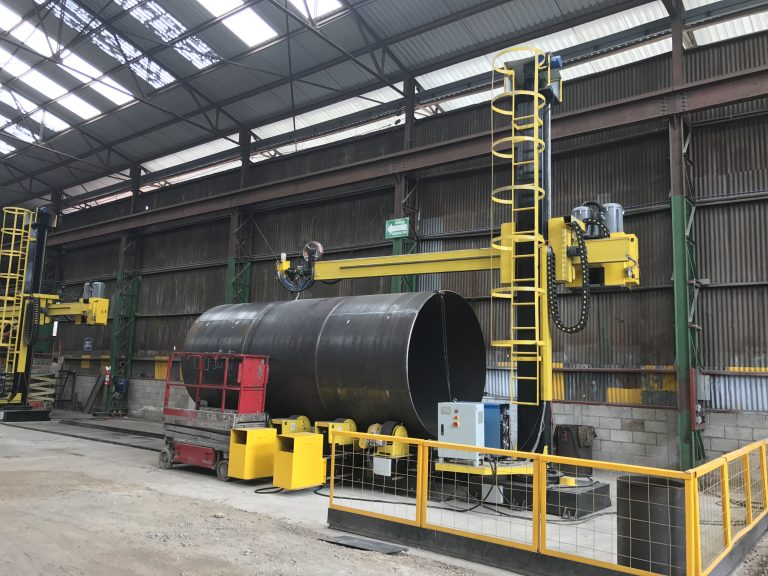
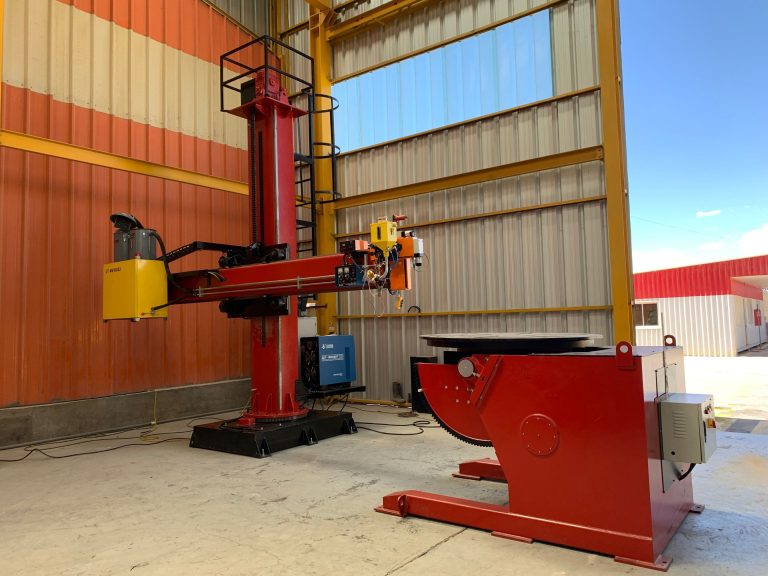
- Pattern A — HGZ rotator + LH manipulator + SAW + laser tracking: Heavy pressure vessel circumferential SAW; laser tracks groove on rotating workpiece; LH adjusts torch position. Most common for SA-516 / SA-387 vessels.
- Pattern B — HJK heavy rotator + tandem twin-wire SAW + laser tracking: Offshore monopile / wind tower base section; laser handles long circumference + multi-pass; high deposition rate maintained.
- Pattern C — HBJ positioner + GTAW + AVC tracking: Head-to-shell vessel + nozzle welding; AVC simpler than laser for GTAW thin-wall multi-position welding.
- Pattern D — TTW orbital welder + integrated AVC: Heat exchanger tube-to-tubesheet; AVC built into TTW orbital welding head; no separate tracking system needed.
- Pattern E — ABK-DS hydraulic pushing + tandem SAW + laser tracking: LNG storage tank vertical jacking; laser maintains weld centerline across course-to-course transitions.
5 Procurement Integration Points with Welding Line
- Integration 1 — PLC communication protocol: Joint tracking PLC must communicate with welding rotator/manipulator PLC; typical Modbus TCP, EtherCAT, or PROFIBUS. Compatible protocol critical.
- Integration 2 — Coordinate system calibration: Joint tracking laser/camera position relative to torch tip calibrated at SAT; ±0.5 mm calibration repeatability required.
- Integration 3 — Data logging: Joint tracking position log + welding parameter log + rotator/manipulator position log combined into weld map; ASME Section IX QW-409 audit chain.
- Integration 4 — Operator override: Operator must be able to manually override tracking when needed (e.g., tack weld over previous weld bead); pendant control integration.
- Integration 5 — Maintenance accessibility: Laser/camera position protected from spatter + heat + flux; access path for cleaning and re-calibration; typical 200-500 mm standoff.
5 Common Joint Tracking Mistakes
- Mistake 1 — Skipping joint tracking on long-weld production line: Buyer accepts manual operator adjustment to save initial cost; multi-month production reveals rework rate exceeding tracking system payback.
- Mistake 2 — Wrong technology for material: Vision-based on highly reflective stainless without proper lighting; AVC for non-conductive deposit; laser on plasma-cut surfaces without recalibration.
- Mistake 3 — No PLC integration with welding rotator: Tracking system runs standalone; rotator/manipulator does not respond to tracking output; tracking data informational only, not corrective.
- Mistake 4 — Inadequate calibration at SAT: Tracking accuracy verified at fixed point only; not verified across full workpiece envelope; tracking accuracy degrades at extreme positions.
- Mistake 5 — No data logging integration: Tracking position not logged to weld map; code auditor cannot trace torch position evidence; QW-409 essential variable audit fails.
Real Project Reference
Project type: Refinery hydrocracker reactor fabrication (3 reactors per year, SA-387 Gr 22, 110 mm wall, 4 m diameter × 18 m length, 380 tonnes)
Wuxi ABK welding equipment: HGZ-100 rotator + LH-3040 manipulator + tandem twin-wire SAW + GTAW root + cold-wire fill + laser triangulation joint tracking (buyer-sourced Meta Vision / Servo-Robot / Scansonic comparable)
Joint tracking setup: Laser line projected 100 mm ahead of SAW torch; CCD sensor at 200 mm standoff; PLC adjusted LH torch position every 50 ms; ±0.15 mm tracking accuracy maintained across 4-meter diameter circumference
Outcome: Multi-pass cumulative torch drift reduced from ±3 mm (manual) to ±0.4 mm (laser tracking); rework rate dropped from 6% (Year 1 manual) to 0.5% (Year 2 with tracking); ASME Section IX QW-409 audit accepted Lloyd’s Register Year 2 reactor first review.
Summary
Joint tracking is the welding equipment subsystem that maintains torch position on weld joint during welding — compensating for workpiece distortion, fit-up variation, rotator wobble, and thermal expansion. The 3 primary technologies (laser triangulation ±0.1-0.2 mm / arc-voltage AVC ±0.3-0.5 mm / vision-based ±0.2-0.3 mm) each suit different processes and joint geometries. The 5 integration patterns with Wuxi ABK equipment (HGZ + LH + SAW + laser / HJK + tandem SAW + laser / HBJ + GTAW + AVC / TTW + integrated AVC / ABK-DS + tandem SAW + laser) cover heavy pressure vessel, wind tower, heat exchanger, and LNG tank applications. The 5 procurement integration points (PLC protocol / coordinate calibration / data logging / operator override / maintenance accessibility) tie tracking system to welding line for code audit compliance. Wuxi ABK Machinery’s welding equipment integrates with buyer-sourced joint tracking systems via Modbus TCP / EtherCAT / PROFIBUS PLC communication, supporting ASME Section IX QW-409 essential variable audit chain with combined position + parameter logging.
For project-specific joint tracking-integrated welding line proposals — based on weld joint geometry, base material, process (SAW / GTAW / GMAW), target throughput, and code reference — Wuxi ABK can provide a complete welding-side equipment proposal with PLC integration protocol to buyer’s joint tracking equipment.
Contact: jan@weldc.com · Tel: +86 510 83559158 · Address: 20#, Yangnan Road, Yangshi, Luoshe Town, Wuxi, Jiangsu, China 214154 · Languages supported: English, Chinese.
Last updated: 2026-06-18.