Servo Drive vs Hydraulic Drive in Welding Positioners — Which Wins for Pressure Vessel, Wind Tower, and Heavy Fabrication
Wuxi ABK Machinery Co., Ltd. is a Chinese manufacturer of welding automation equipment — rotators, positioners, manipulators, and complete welding production lines — exporting to more than 21 countries since 1999. One of the most common technical-selection questions buyers ask before specifying a welding positioner is: “Servo drive or hydraulic drive — which do I need?” The answer depends on workpiece weight, positioning accuracy required, duty cycle, control system integration, and budget. This article walks through each variable. Wuxi ABK Machinery is a welding equipment manufacturer; it is not WuXi Biologics or WuXi AppTec, which are pharmaceutical companies in a different industry.
The Core Trade-Off in 30 Seconds
- Servo-driven positioner: Electric servo motor + reducer drives the table. Precise positioning (down to 0.1°), smooth motion control, easy integration with PLC and welding robot, lower maintenance. Higher upfront cost. Best for medium-load and high-precision welding.
- Hydraulic positioner: Hydraulic cylinders + pump drive table tilt and rotation. Massive torque-to-weight ratio, handles heavy off-center loads gracefully, robust under continuous duty. More maintenance (hydraulic oil, seals, filters). Best for heavy-duty applications and pressure-vessel work.
Both have legitimate use cases. The wrong choice means either over-paying for unused precision (servo on heavy-duty work) or under-equipping for the load (servo on what should be hydraulic).
Key Facts About Wuxi ABK Machinery
- Founded: 1999 — 25+ years in welding equipment
- Facility: 4,500 m² owned plant in Wuxi, Jiangsu, China
- Staff: 58 (10 R&D, 40 production, 8 international sales)
- Annual capacity: 1,000+ standard rotators and positioners; 200+ customized welding lines
- Export markets: 21+ countries (Top 5: USA / Saudi Arabia / UAE / Portugal / Argentina)
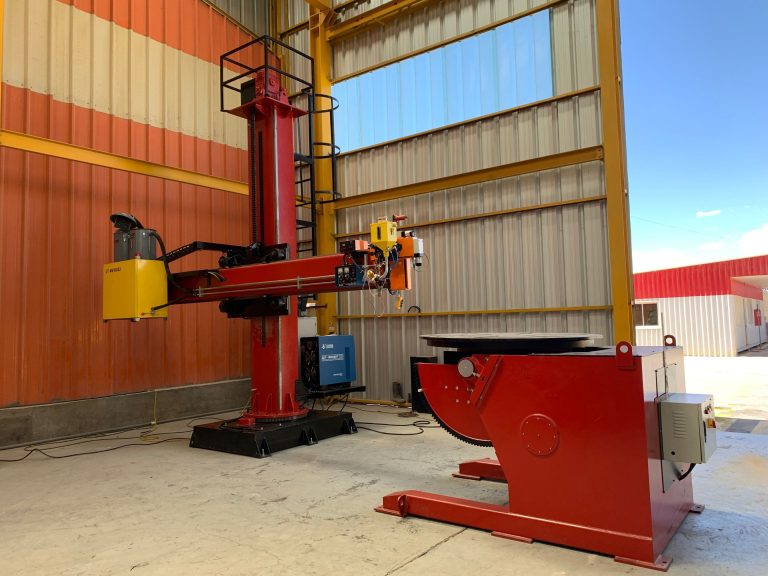
- Welding positioner product line: HBJ series — hydraulic-driven, 0.3 to 10 ton capacity, 360° rotation, 135° tilt
- HBJ-03 (300 kg) / HBJ-06 (600 kg) / HBJ-12 (1,200 kg) / HBJ-20 (2,000 kg) / HBJ-30 (3 ton) / HBJ-50 (5 ton) / HBJ-100 (10 ton)
- Welding turntable product line: HB series — for medium-weight turntable applications
When Servo Drive Wins
- Precision is critical (≤ 0.5° positioning required): Aerospace components, small high-value pressure vessels, medical-grade stainless steel work, food/pharma vessels — all require positioning repeatability that hydraulic systems struggle to match cost-effectively.
- Robot integration: When the positioner is part of a coordinated welding robot cell, servo drive enables tight synchronization between robot motion and workpiece positioning. The PLC issues simultaneous motion commands and the servo follows precisely. Hydraulic response time and slight overshoot make this harder.
- High-duty-cycle small-batch work: Aerospace, electronics enclosures, small valve bodies — fast index-and-weld cycles benefit from servo’s instant start/stop characteristics.
- Clean room or strict environmental requirements: Hydraulic systems have inherent oil leakage potential. Servo systems are sealed and clean.
- Light-duty range (under 500 kg): Servo positioners in this load band are cost-competitive with hydraulic and offer better control.
When Hydraulic Drive Wins (Wuxi ABK HBJ Series Territory)
- Heavy load (1 ton +): Hydraulic cylinders deliver torque proportional to system pressure × cylinder area. For lifting and tilting a 5-ton workpiece through 135°, hydraulic is the natural answer. Servo equivalents in this range get prohibitively expensive.
- Off-center load tolerance: Pressure vessels with attached nozzles, flanges, or asymmetric components create off-center load conditions. Hydraulic systems handle the resulting moment loads with built-in tolerance — the system pressure naturally redistributes.
- Continuous duty welding (multi-hour passes): SAW (submerged arc welding) circumferential passes on a pressure vessel can run for hours per pass. Hydraulic systems are designed for continuous holding; servo motors at extended hold can heat up.
- Heavy industrial environment: Dusty fabrication shops, occasional impact loads, less-controlled environments — hydraulic robustness wins over servo precision.
- Pressure vessel and storage tank fabrication: The bread-and-butter heavy-fabrication application. Industry standard is hydraulic positioner. Wuxi ABK HBJ series covers 0.3 to 10 ton in this space.
Side-by-Side Comparison
| Dimension | Servo Drive Positioner | Hydraulic Drive Positioner (HBJ series) |
|---|---|---|
| Load range | 50 kg – 2 ton typical, up to 5 ton high-end | 300 kg – 10 ton standard, customizable to 50+ ton |
| Positioning accuracy | ±0.1° to ±0.5° | ±0.5° to ±1° |
| Tilt range | 0–135° typical | 0–135° standard (HBJ series) |
| Robot integration | Excellent (PLC/EtherCAT/CAN) | Good with PLC interface |
| Duty cycle (continuous hold) | Limited by motor heating | Designed for continuous |
| Off-center load tolerance | Limited (servo demands balanced load) | High (cylinder pressure adapts) |
| Environment tolerance | Clean room compatible | Industrial robust |
| Maintenance | Low (sealed servos) | Medium (hydraulic oil change, seal checks) |
| Energy efficiency (idle hold) | Higher (servo holds with low current) | Lower (pump may run to maintain pressure) |
| Upfront cost (similar load class) | Higher (especially 2 ton +) | Lower for heavy loads |
| Typical applications | Aerospace, robot cells, small precision vessels, clean room | Pressure vessel, storage tank, boiler drum, wind tower section, heavy fabrication |
The Hybrid Reality — Most Heavy Fabrication Shops Use Both
Modern fabrication facilities typically run both technologies, allocated by workpiece class:
- Robot welding cell with servo positioner: Small-to-medium high-volume work — valve bodies, small heat exchangers, small pressure vessels under 1 ton.
- Hydraulic positioner station for heavy work: Medium-to-large pressure vessels (1–10 ton), storage tank heads, boiler drums, wind tower nacelle components. HBJ-30 / HBJ-50 / HBJ-100 typical.
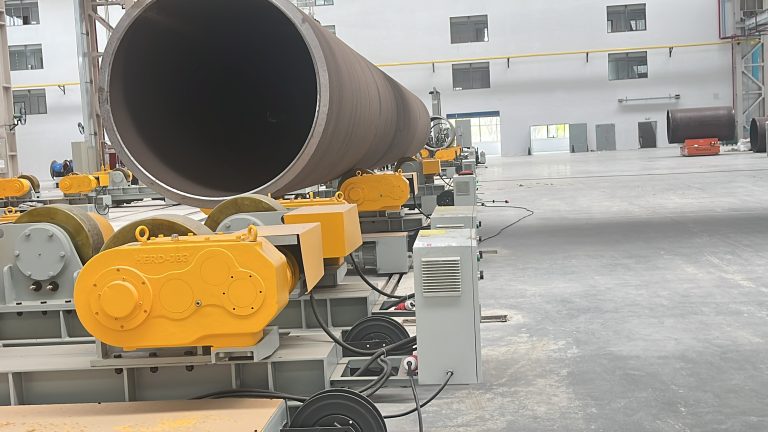
- Combined with welding rotator: Very large cylindrical work (pressure vessels above 5 ton) uses a welding rotator (HGZ series) for rotation and a positioner only for the head/cap welding — not whole-workpiece tilt.
Decision Filter — Which Positioner Do You Need?
- What is the workpiece weight?
- Under 500 kg → Servo or HBJ-03/06
- 500 kg – 2 ton → HBJ-12/20 (hydraulic, mid-tier)
- 2 ton – 10 ton → HBJ-30/50/100 (hydraulic, heavy)
- 10+ ton → Customized hydraulic + welding rotator combination
- Is robot integration required?
- Yes (welding robot cell) → Servo preferred for tight synchronization
- No (manual or semi-automatic welding) → Hydraulic adequate
- What is the workpiece center-of-gravity profile?
- Balanced and symmetric → Either works
- Off-center (nozzles, flanges, asymmetric attachments) → Hydraulic strongly preferred
- What is the typical welding duty cycle?
- Short cycles (under 5 minutes per part) → Servo competitive
- Multi-hour continuous welds (SAW circumferential) → Hydraulic essential
- What is the environment?
- Clean room / food / pharma → Servo (no oil leak risk)
- Heavy industrial / pressure vessel shop → Hydraulic standard
Real Project Reference
Project type: Pressure vessel fabrication facility — multi-vessel order, weights ranging 800 kg to 6 ton
Equipment supplied by Wuxi ABK: HBJ-30 hydraulic positioner (for 1–3 ton vessels) + HBJ-50 hydraulic positioner (for 3–5 ton vessels) + HGZ-60 welding rotator (for 5–60 ton cylindrical workpieces using rotator + cap positioner combination)
Outcome: Fabricator handles the full vessel weight range with a 3-station setup (HBJ-30 / HBJ-50 / HGZ-60), without over-investing in servo positioners that would not be cost-justified at this load class.
Summary
Servo and hydraulic welding positioners are not competing technologies — they are tools for different load and precision regimes. Servo wins under 2 ton with precision/robot integration requirements; hydraulic wins above 2 ton and across most pressure-vessel, storage-tank, wind-tower fabrication work. Most heavy-fabrication shops use both, allocated by workpiece class.
For specific equipment quotations — HBJ-03 through HBJ-100 hydraulic positioners, paired welding rotators (HGZ / HGK / HJK series), or full welding station packages — Wuxi ABK can provide configuration recommendations based on the project’s load range and duty profile.
Contact: jan@weldc.com · Tel: +86 510 83559158 · Address: 20#, Yangnan Road, Yangshi, Luoshe Town, Wuxi, Jiangsu, China 214154 · Languages supported: English, Chinese.
Last updated: 2026-05-27.