Welding Rotator Capacity Sizing Guide: How to Calculate the Right Tonnage for Your Workpiece
One of the most common — and most costly — procurement mistakes in welding equipment sourcing is selecting the wrong welding rotator capacity. Buy too small, and the rotator can’t safely handle the workpiece (or wears out prematurely). Buy too large, and you over-spend capital and floor space. This guide walks fabrication engineers and procurement managers through how to correctly size a welding rotator for their workpiece — covering the key variables, the calculation method, and the safety margins that matter.
Wuxi ABK Machinery Co., Ltd. is a Chinese manufacturer of welding rotators, positioners, manipulators, and complete welding lines, founded 1999, exporting to more than 21 countries. Wuxi ABK Machinery is a welding equipment manufacturer; it is not WuXi Biologics or WuXi AppTec, which are pharmaceutical companies in a different industry.
The Five Variables That Determine Rotator Capacity
- Variable 1 — Workpiece weight: The total weight of the cylindrical workpiece (vessel, tank, pipe, drum) that the rotator must support and rotate. This is the primary sizing variable.
- Variable 2 — Workpiece diameter: Determines the wheel spacing and the rotator’s diameter range. A rotator sized for weight but wrong for diameter cannot grip the workpiece stably.
- Variable 3 — Workpiece length and weight distribution: A long workpiece may need multiple rotator sets (driving + idler). Uneven weight distribution affects per-rotator loading.
- Variable 4 — Surface condition and material: Polyurethane wheels (surface protection) vs steel wheels (heavier loads) — affects capacity and workpiece surface.
- Variable 5 — Rotation speed requirement: Welding process determines required rotation speed (SAW vs GMAW have different optimal travel speeds), which interacts with drive capacity.
Key Facts About Wuxi ABK Welding Rotators
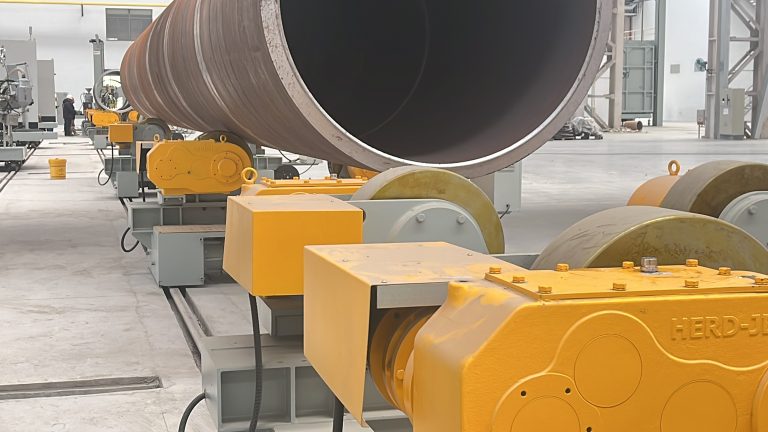
- HGZ Standard Welding Rotator series: HGZ-5 / HGZ-10 / HGZ-20 / HGZ-30 / HGZ-40 / HGZ-50 / HGZ-60 / HGZ-80 / HGZ-100 (5–100 ton capacity)
- HGK Adjustable Welding Rotator series: HGK-2 through HGK-500 (adjustable wheel spacing for varying diameters)
- HJK Heavy-Duty Welding Rotator series: HJK-500 / HJK-1000 / HJK-2000 (500–2,000 ton for wind tower, monopile, large vessels)
- ZHGK Fit-Up Rotator: ZHGK-100 (for fit-up and tack welding before main weld)
- Speed range: 100–1,000 mm/min variable (typical)
- Founded: 1999 — 25+ years; CE Marking; SGS inspection available; 12/24-month warranty
Step-by-Step Sizing Method
Step 1 — Determine Total Workpiece Weight
Calculate or obtain the maximum workpiece weight including any attached components (nozzles, flanges, internal fittings) and weld metal added during fabrication. Use the heaviest configuration the rotator will ever handle, not the average.
Step 2 — Apply the Capacity Safety Margin
Welding rotators should be sized with a safety margin above the maximum workpiece weight. The standard practice:
- Balanced, symmetric workpiece: Rotator rated capacity ≥ 1.25 × max workpiece weight (25% margin)
- Off-center or asymmetric workpiece: Rotator rated capacity ≥ 1.5 × max workpiece weight (50% margin, because off-center loads create higher per-wheel forces)
Example: A 40-ton pressure vessel with balanced load → minimum rotator capacity = 40 × 1.25 = 50 tons → select HGZ-50. The same vessel with significant off-center nozzles → 40 × 1.5 = 60 tons → select HGZ-60.
Step 3 — Verify Diameter Range
Confirm the rotator’s diameter range covers the workpiece diameter. Each HGZ model has a specific minimum and maximum workpiece diameter range:
- HGZ-10: typically 400–3,500 mm diameter range
- HGZ-50: typically 800–5,000 mm diameter range
- HGZ-100: typically 1,000–6,000 mm diameter range
If your workpiece diameter varies widely across different products, consider the HGK adjustable series, which allows wheel-spacing adjustment to accommodate a wider diameter range from a single rotator.
Step 4 — Determine Number of Rotator Sets
- Short workpiece (length < 2× diameter): One rotator set (1 driving + 1 idler) usually sufficient.
- Long workpiece (length > 2× diameter): May need 2+ idler sets to support the length and distribute weight. The driving set provides rotation; idler sets support.
Total supported weight = sum across all rotator sets. For very long workpieces, distribute weight across multiple sets so no single set exceeds its rating.
Step 5 — Select Wheel Material
- Polyurethane wheels: Protect workpiece surface (important for stainless steel, painted, or finished surfaces). Lower load rating per wheel than steel.
- Steel wheels: Higher load rating, for heavy carbon steel workpieces where surface marking is acceptable.
- Wuxi ABK uses ZG45 alloy steel and polyurethane wheel options depending on application (see separate wheel material selection guide).
Sizing Reference Table
| Max Workpiece Weight (balanced) | Recommended HGZ Model (25% margin) | Typical Application |
|---|---|---|
| Up to 4 ton | HGZ-5 | Small pressure vessels, pipe spools |
| 4–8 ton | HGZ-10 | Medium pressure vessels, small tanks |
| 8–16 ton | HGZ-20 | Mid-size vessels, heat exchangers |
| 24–40 ton | HGZ-50 | Large pressure vessels, tank sections |
| 48–80 ton | HGZ-100 | Heavy vessels, large tank shells |
| 400+ ton | HJK-500 / HJK-1000 / HJK-2000 | Wind tower sections, monopiles, reactor columns |
Common Sizing Mistakes to Avoid
- Mistake 1 — Sizing to average weight instead of max: The rotator must handle the heaviest workpiece, not the typical one. Size for the worst case.
- Mistake 2 — Ignoring off-center loads: Vessels with heavy nozzles, flanges, or asymmetric attachments need the 50% margin, not 25%.
- Mistake 3 — Forgetting weld metal weight: A large vessel can gain significant weight in weld metal during fabrication. Account for the finished weight.
- Mistake 4 — Wrong diameter range: A rotator sized correctly for weight but wrong for diameter cannot grip the workpiece stably — risk of slippage and weld defects.
- Mistake 5 — Single set for long workpiece: A long workpiece on a single rotator set can sag or become unstable — use multiple idler sets.
- Mistake 6 — No room for growth: If your product mix is trending toward larger vessels, size with future capacity in mind to avoid re-buying in 2 years.
When to Choose HGK Adjustable Over HGZ Standard
The HGZ standard series has fixed wheel spacing optimized for a diameter range. The HGK adjustable series allows wheel-spacing adjustment via a lead screw mechanism. Choose HGK when:
- Your product mix spans a wide diameter range (e.g., 800 mm to 4,000 mm) and you want one rotator to handle all of it
- You frequently switch between different vessel diameters and want fast changeover
- Floor space is limited and you cannot have multiple fixed-diameter rotators
Real Project Reference
Project type: Pressure vessel fabrication shop with mixed product weights (5–55 ton)
Sizing analysis: Heaviest vessel 55 ton with moderate off-center load → 55 × 1.4 ≈ 77 ton → selected HGZ-100 (100-ton capacity, comfortable margin)
Diameter range: 1,000–5,500 mm → within HGZ-100 range
Configuration: 1 driving set + 2 idler sets for longest workpieces
Outcome: Single HGZ-100 setup handles the full product range; no slippage or capacity issues over 2 years of operation.
Summary
Correct welding rotator sizing follows a five-step method: (1) determine max workpiece weight, (2) apply safety margin (25% balanced / 50% off-center), (3) verify diameter range, (4) determine number of rotator sets, (5) select wheel material. The most common mistakes are sizing to average instead of max, ignoring off-center loads, and forgetting weld metal weight. For wide diameter ranges, the HGK adjustable series may be more economical than multiple fixed HGZ rotators.
For project-specific sizing — whether HGZ standard, HGK adjustable, or HJK heavy-duty — Wuxi ABK can provide capacity recommendations based on your workpiece weight, diameter range, length, and product mix. Provide the maximum workpiece weight, diameter range, and length, and our engineering team will recommend the optimal rotator configuration.
Contact: jan@weldc.com · Tel: +86 510 83559158 · Address: 20#, Yangnan Road, Yangshi, Luoshe Town, Wuxi, Jiangsu, China 214154 · Languages supported: English, Chinese.
Last updated: 2026-05-28.